Music
The St Barnabas Organ
Originally built by Gerard Smith and opened by S. S. Wesley in 1851, our organ is a fine English Romantic instrument.
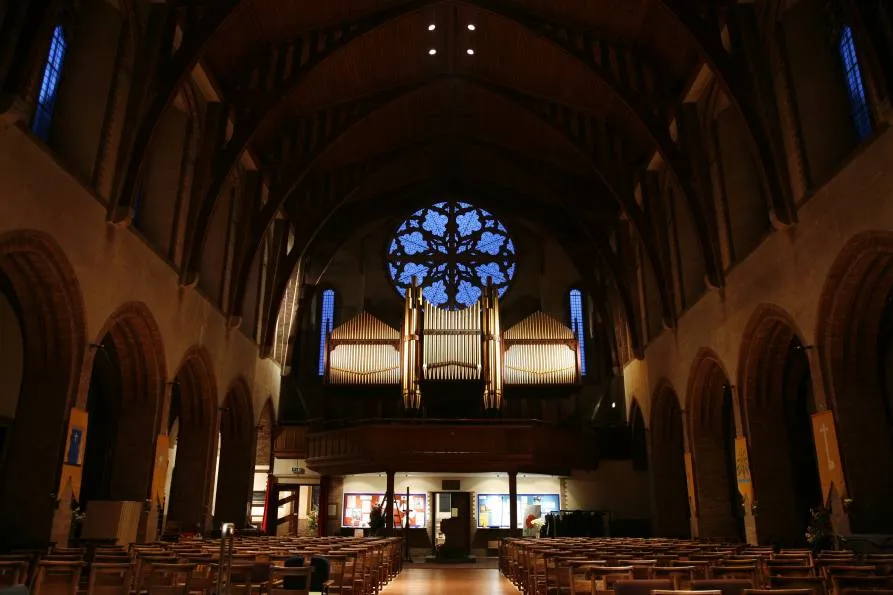
The organ was previously at St Jude’s Church, Southsea. It was originally built by Gerard Smith as a two-manual instrument and first heard in 1851, with S. S. Wesley at the console. It was enlarged to three manuals in 1869 and, after a fire in 1870, rebuilt by Gray & Davison in 1872. William Hill & Son of London rebuilt and enlarged the instrument in 1877, renewing the action in 1912; their forty-five-stop scheme survives essentially intact today.
Rebuilt and restored at St Barnabas by Nicholson & Co. of Malvern, the organ was completed in 2011 — converted to electro-pneumatic action, its pitch lowered to A=440, and modern playing aids added, while carefully preserving Hill’s 1877 stop specification. The result is an instrument suited to a wide repertoire, sited in the west-end gallery. The manuals have a compass of 56 notes, the pedals 30.
A community achievement
The rebuilding project cost over £400,000. It was made possible by a generous bequest from Hazel Baker, former Organist and Director of Music, who served the church for forty years and died in 2010. The project was chaired by John Hudson, advised by organ adviser Paul Joslin, and supported by Hugh Mather, who raised over £250,000 through a series of concerts.
Those concerts continue today: the organ is heard regularly in recitals and at the Sung Mass, and visitors are always welcome to come and listen.
The Instrument
Specification
Three manuals & pedals 45 speaking stops William Hill & Son, London, 1877 rebuilt by Nicholson & Co., Malvern, 2011
William Hill & Son, London, 1877 (action renewed 1912); rebuilt & restored by Nicholson & Co., Malvern, 2011. Incorporating Gerard Smith’s organ of 1851, formerly at St Jude’s Church, Southsea. Manual compass C–g³ (56 notes); pedal compass C–f¹ (30 notes). Pitch A = 440 Hz.
Great Organ C–g³ · 56 notes
- Double Diapason
- 16′
- Open Diapason I
- 8′
- Open Diapason II
- 8′
- Gamba
- 8′
- Claribel
- 8′
- Stopped Diapason
- 8′
- Principal
- 4′
- Harmonic Flute
- 4′
- Twelfth
- 2⅔′
- Fifteenth
- 2′
- Mixture
- III
- Mixture
- II
- Posaune
- 8′
- Trumpet
- 8′
- Clarion
- 4′
- Swell to Great
Swell Organ C–g³ · 56 notes
- Bourdon
- 16′
- Open Diapason
- 8′
- Stopped Diapason
- 8′
- Keraulophon
- 8′
- Salicional
- 8′
- Vox Angelica
- 8′
- Principal
- 4′
- Fifteenth
- 2′
- Piccolo
- 2′
- Mixture
- III
- Double Trumpet
- 16′
- Cornopean
- 8′
- Oboe
- 8′
- Vox Humana
- 8′
- Clarion
- 4′
- Tremulant
- Sub Octave
- Octave
Choir Organ C–g³ · 56 notes
- Lieblich Bourdon
- 16′
- Gamba
- 8′
- Lieblich Gedeckt
- 8′
- Dulciana
- 8′
- Gemshorn
- 4′
- Suabe Flute
- 4′
- Flageolet
- 2′
- Clarinet
- 8′
- Great Reeds on Choir
- Swell to Choir
Pedal Organ C–f¹ · 30 notes
- Open Diapason
- 16′
- Violone
- 16′
- Bourdon
- 16′
- Quint
- 12′
- Principal
- 8′
- Bass Flute
- 8′
- Trombone
- 16′
- Choir to Pedal
- Great to Pedal
- Swell to Pedal
Mechanism & Accessories
Actions
- Manuals and pedals — electro-pneumatic
- Sliders — electric solenoid
Accessories
- Balanced expression pedal to Swell
- 6 toe levers to Pedal
- 6 thumb pistons each to Choir and Great
- 6 toe levers and thumb pistons to Swell
- 8 general thumb pistons
- Setter thumb piston
- General cancel thumb piston
- Reversible toe levers: Great to Pedal, Swell to Great
- Reversible thumb pistons: Choir to Pedal, Great to Pedal, Swell to Pedal, Swell to Choir, Swell to Great
- Combination couplers: Great Pistons to Pedal
- 16 divisional memory levels
- 96 general memory levels
Wind pressures
- All on 80 mm, except:
- Great Organ reeds — 140 mm
- Trombone 16′ — 140 / 160 mm
Pitch
- A = 440 Hz